Save up to 40% on
parcel forwarding
from USA to Bangladesh

20 Cons of Parcel Forwarding: Risks, Limitations, and Common Drawbacks
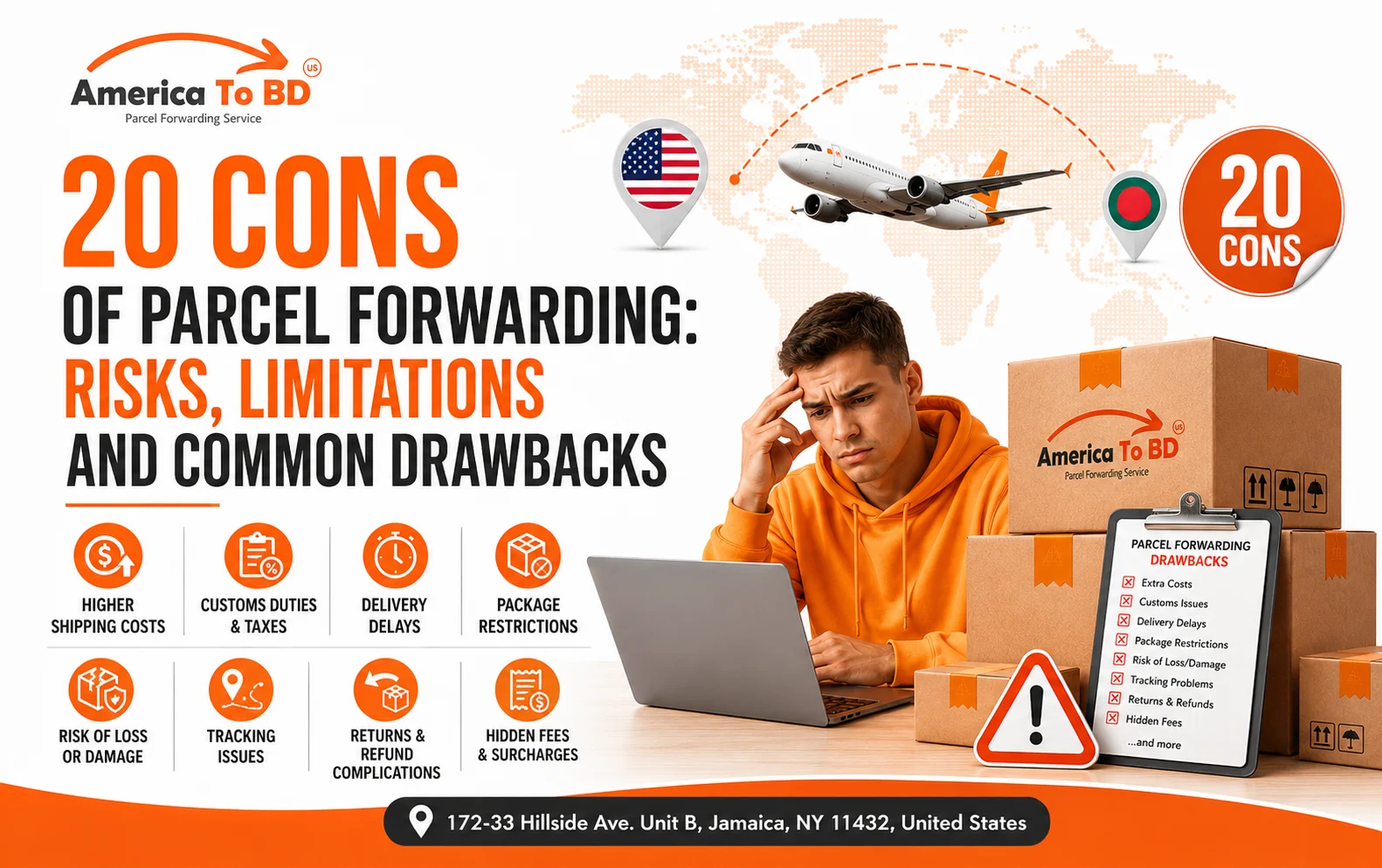
Before you rely on a forwarding service for an important purchase, it helps to understand what can go wrong: customs delays, unexpected fees, restricted items, and more. Knowing these limitations in advance isn't about discouraging you from using parcel forwarding; it's about helping you plan around the pitfalls, choose a trustworthy provider, and avoid costly surprises. If you're new to the concept altogether, our pillar guide, "What is Parcel Forwarding?", covers the basics of how the process works from start to finish. Parcel forwarding involves more moving parts than a simple domestic delivery: a U.S. warehouse, an international carrier, Bangladesh Customs, and a final-mile courier all have to work together. Most of the drawbacks below stem from that added complexity rather than from the concept of forwarding itself. The good news is that nearly every risk can be minimized simply by choosing a reputable, experienced forwarding company and understanding the shipping and customs rules before you order. Parcels forwarded from the U.S. to Bangladesh travel much farther than a domestic shipment, passing through multiple hubs, customs checkpoints, and transit points before reaching the final delivery address. Example: a package that would arrive in three days domestically inside the U.S. can take one to several weeks once it enters the international leg of the journey. Why it happens: This happens because international parcels are consolidated into larger freight loads, screened at customs, and rerouted through regional hubs rather than moving directly point-to-point. How to reduce it: Choose a forwarder that offers real-time tracking and realistic delivery estimates, and avoid ordering time-sensitive items (like event outfits or gifts) too close to the date you need them. Every international shipment must pass through customs in the destination country, and Bangladesh Customs, operating under the National Board of Revenue (NBR), may hold a parcel for document review, valuation checks, or physical inspection. Example: A package can sit at the port or airport customs area for several extra days if paperwork is incomplete or the shipment is selected for manual review. Why it happens: Clearance delays usually stem from missing invoices, unclear item descriptions, or shipments that require additional verification under the Customs Act. How to reduce it: Provide accurate invoices and item descriptions upfront, and use a forwarder experienced in USA-to-Bangladesh shipments who understands what documentation Bangladesh Customs typically expects. Bangladesh calculates import duty and tax using the CIF method, which factors in the cost of goods, insurance, and freight combined, not just the item's price. Example: A $100 item can end up costing noticeably more once duty, VAT, and other charges are added, especially for categories with higher tariff rates. Why it happens: This happens because duty rates in Bangladesh vary by product category, generally between 0% and 25%, with additional VAT (up to 15%), advance income tax, and a supplementary duty on luxury items such as perfume, alcohol, and tobacco. How to reduce it: Check the general duty category of what you're ordering before purchasing, keep receipts for accurate declared values, and budget for taxes rather than assuming the checkout price is the final cost. Not everything that can legally be bought in the U.S. can legally be shipped to Bangladesh. Certain goods are restricted, require special permits, or are outright prohibited from import. Example: Items such as certain electronics, batteries, food products, alcohol, or specific chemicals may require prior approval or cannot be shipped at all. Why it happens: Bangladesh's Import Policy Order and customs regulations restrict or prohibit categories of goods to protect health, safety, revenue, and domestic industry. How to reduce it: Always check a forwarder's prohibited and restricted items list before purchasing, and ask customer support if you're unsure about a specific product category. International shipping is priced primarily by weight, and small, dense items can cost more to ship than expected once packaging and documentation weight are added. Example: A pair of heavy boots, for instance, may cost noticeably more to forward than a lightweight t-shirt of similar retail price. Why it happens: This happens because international couriers charge per-kilogram or per-pound rates that scale directly with total shipment weight, not item value. How to reduce it: Use a shipping calculator before ordering, and consider consolidating multiple lightweight items into a single shipment to spread the base handling cost. Couriers also charge based on a package's dimensional weight, calculated from its length, width, and height, and bill whichever is higher: actual weight or dimensional weight. Example: A large but lightweight item, like a bulky pillow or an oversized box with excess packaging, can be billed at a much higher weight than what the scale shows. Why it happens: This happens because carriers price for the space a package occupies in a plane or container, not just its mass, since bulky-but-light shipments take up valuable cargo room. How to reduce it: Ask your forwarder about repackaging into a smaller, well-fitted box, and avoid excess void fill or oversized retailer packaging when possible. Beyond the base shipping cost, forwarders may charge for services like storage beyond a free period, package consolidation, repackaging, insurance, or address corrections. Example: A shipment held at the warehouse for an extended time while waiting for other orders to arrive may accrue a small storage fee once any free storage window expires. Why it happens: These fees exist because handling, storage space, and labor have real costs that a flat shipping rate alone doesn't cover. How to reduce it: Read the forwarder's fee schedule in advance, consolidate orders promptly, and ask for a full cost breakdown before authorizing a shipment. Packages pass through multiple hands, vehicles, and sorting facilities on their journey, which increases the chance of rough handling compared to a single-leg domestic delivery. Example: Fragile items like glassware, electronics, or cosmetics are more vulnerable if not packed with adequate cushioning for a long multi-leg journey. Why it happens: This happens due to the sheer number of touchpoints in international logistics, plus the added strain of longer transit times and multiple transfers between carriers. How to reduce it: Request professional repackaging for fragile goods, ask your forwarder about protective packing materials, and consider insurance for higher-value or delicate items. While uncommon with reputable, trackable services, packages can occasionally be misrouted, misplaced, or lost, particularly during multi-carrier international transfers. Example: A parcel that changes hands between a domestic courier, the forwarder's warehouse, and an international carrier has more points where a tracking or handling error could occur. Why it happens: This risk increases with untracked or budget shipping options that offer limited scan checkpoints along the route. How to reduce it: Always choose a fully trackable shipping method, keep your tracking number and order confirmations, and report any tracking gaps to your forwarder promptly. Basic shipping often includes only limited liability coverage, meaning a lost or damaged high-value item might not be fully reimbursed unless additional insurance was purchased. Example: Someone shipping an expensive laptop without opting into extra insurance may find the standard carrier liability doesn't cover the full replacement cost. Why it happens: This happens because base shipping rates are priced assuming standard liability limits, with full-value protection offered only as an add-on. How to reduce it: For valuable items, purchase additional insurance coverage and keep proof of purchase and value documentation in case a claim is needed. Customs declarations must accurately describe the contents, value, and quantity of a shipment. Errors, whether accidental or intentional, can trigger delays, fines, or seizure. Example: A vaguely labeled package, such as listing 'gift' or 'miscellaneous items' instead of specific contents, is more likely to be flagged for manual review. Why it happens: This happens because customs authorities rely on declared information to assess duty and screen for prohibited goods, and unclear declarations invite closer scrutiny. How to reduce it: Always provide the retailer invoice, list specific item descriptions, and declare accurate values rather than underdeclaring to reduce duty, which can result in penalties. A single incorrect digit in an address, phone number, or postal code can send a package to the wrong location or delay final-mile delivery within Bangladesh. Example: Final-mile delivery networks in some areas rely heavily on accurate phone contact for confirming delivery, so an outdated number can stall a shipment. Why it happens: This happens because international shipments pass through multiple systems where address data can be re-entered or reformatted, increasing the chance of a typo. How to reduce it: Double-check the delivery address and phone number at checkout, and confirm the local courier partner's delivery process with your forwarder. If an item needs to be returned to a U.S. retailer after it has already been forwarded internationally, the process becomes far more complex and costly than a standard domestic return. Example: A customer who receives the wrong size and wants to return it may find that return shipping from Bangladesh back to a U.S. warehouse costs nearly as much as the item itself. Why it happens: This happens because most retailers only provide prepaid return labels for domestic U.S. addresses, not international ones. How to reduce it: Inspect items carefully before requesting forwarding, use a forwarder's package inspection or photo service to verify contents first, and factor return costs into your purchase decision. Even with an efficient forwarder, international shipping to Bangladesh will generally take longer than shopping from a local Bangladeshi retailer, due to the added customs and transit legs. Example: Someone ordering electronics for a specific event should expect the process, from purchase to final delivery, to take meaningfully longer than a local same-week purchase. Why it happens: This happens because the shipment must complete a domestic U.S. leg, warehouse processing, international transit, customs clearance, and local final-mile delivery. How to reduce it: Plan ahead for occasions or deadlines, order early, and ask your forwarder for a realistic delivery window rather than the fastest-case estimate. Some U.S. retailers restrict shipping to addresses they detect as freight-forwarding or reshipping warehouses, sometimes canceling orders or blocking checkout entirely. Example: A customer trying to order from a retailer with strict anti-fraud address screening may find their order flagged or refused at checkout. Why it happens: This happens because some retailers use fraud-prevention systems that flag known forwarder warehouse addresses to reduce chargeback and fraud risk. How to reduce it: Use your forwarder's suite number correctly, check whether the retailer has known restrictions, and consider a 'Purchase & Forward' or personal shopping service where the forwarder buys on your behalf. Certain product categories, including some electronics, health products, and food items, face additional import restrictions or require conformity certificates in Bangladesh. Example: Items like certain health and beauty products or electrical goods may require a certificate of conformity or additional review before customs releases them. Why it happens: This happens because Bangladesh regulates specific categories to meet Bangladesh Standards (BDS) and safety requirements for goods entering the market. How to reduce it: Research any category-specific requirements before ordering, and ask your forwarder whether a product type is known to require extra documentation. During peak periods, such as major holidays, Eid, or global shopping events like Black Friday, international shipping volumes surge, which can slow processing at every stage of the chain. Example: A shipment ordered during a high-volume sale period may take noticeably longer to leave the warehouse and clear customs than the same shipment sent during a quieter month. Why it happens: This happens because warehouses, couriers, and customs offices all face higher volume with the same staffing and processing capacity during peak seasons. How to reduce it: Order early ahead of major holidays or sales events, and set expectations that peak-season shipments may take longer than the average estimate. Since purchases are made in U.S. dollars but duties and daily expenses in Bangladesh are in taka, exchange rate movement between the order date and delivery can affect the real cost of a shipment. Example: A shipment ordered when the dollar is strong against the taka may end up costing more in local currency terms by the time duties are assessed and paid. Why it happens: This happens because currency values shift daily based on global markets, and there is typically a time gap between purchase, shipping, and customs assessment. How to reduce it: Keep an eye on exchange rate trends if timing a large purchase, and build a small buffer into your budget for potential currency shifts. Tracking information doesn't always update in real time, especially during the international transit and customs clearance legs, which can cause unnecessary worry even when the shipment is progressing normally. Example: A package may show no tracking movement for several days while it's actually being processed through a customs facility, only to update again once it's released. Why it happens: This happens because customs facilities and international handoffs don't always scan and upload tracking data as frequently as domestic couriers do. How to reduce it: Avoid panicking over a few quiet tracking days, and contact your forwarder's support team if there's no update for an unusually long stretch. The single biggest risk in parcel forwarding isn't the process itself; it's choosing a forwarder with poor communication, hidden fees, weak security, or no real customer support. Example: A customer who signs up with an unverified, low-cost forwarder may face unexpected charges, unresponsive support, or packages that sit unprocessed for weeks. Why it happens: This happens because the forwarding industry has a wide range of providers, and not all maintain the same standards for security, transparency, or service quality. How to reduce it: Research a forwarder's reputation, look for transparent pricing and clear communication, and prioritize companies with dedicated experience shipping specifically to Bangladesh. Not all of these risks carry equal weight. Weight-based pricing, dimensional weight charges, customs duties, and longer delivery times are the most common realities of parcel forwarding; nearly every shipment will involve at least one of these considerations, simply because they're built into how international shipping works. Customs clearance delays, incorrect declarations, and retailers refusing forwarding addresses happen occasionally, often tied to specific product categories or documentation gaps rather than the shipping process as a whole. Lost packages, major transit damage, and choosing an unreliable forwarder are the least common outcomes when a customer works with an established, trackable, well-reviewed service, but they represent the highest-impact risks when they do occur. Reputable forwarding companies reduce these risks through package inspection before shipping, transparent fee disclosure, accurate customs documentation support, and responsive customer service that can intervene quickly if something goes wrong. Choose a trusted provider with a track record specifically shipping to Bangladesh, not just a generic global forwarder. Read the prohibited and restricted items list before purchasing anything you're unsure about. Declare package values accurately; underdeclaring to save on duty can lead to penalties or seizure. Purchase additional insurance for high-value or fragile items rather than relying on base carrier liability. Consolidate shipments wisely, balancing shipping savings against the dimensional weight of a larger combined box. Take time to understand Bangladesh's general customs and duty structure before ordering expensive items. Track shipments regularly, but don't be alarmed by a few quiet days during international transit or customs processing. Use accurate, complete shipping information, including a working phone number for final-mile delivery. Weighed honestly, the advantages of parcel forwarding- access to U.S.-exclusive products, competitive American pricing, and the ability to shop retailers that don't ship internationally generally outweigh the drawbacks for most shoppers. The risks outlined above are real, but they're also manageable. Almost every one of them can be reduced significantly by working with an experienced, transparent forwarding company and by doing a small amount of homework before you buy. The customers who run into serious problems are usually the ones who skip that homework: ordering restricted items, ignoring fee schedules, or choosing the cheapest, least established forwarder available. For everyone else, parcel forwarding remains one of the more practical ways to shop the U.S. market from Bangladesh. A number of the risks covered in this article are directly addressed by the way a well-run forwarding service is structured. America To BD USA, a parcel forwarding service built specifically for the U.S.-based Bangladeshi diaspora and shoppers in Bangladesh, applies several practices aimed at reducing these common pain points: A secure U.S. warehouse address for receiving purchases from American retailers. Package inspection so customers can confirm contents and condition before international shipping. Package consolidation options to help reduce per-shipment costs when ordering from multiple retailers. Shopping assistance for retailers that restrict or refuse forwarding addresses, through a Purchase & Forward-style service. Transparent pricing, including a shipping calculator, so customers can estimate costs before committing. Customer support to help resolve documentation, tracking, or delivery issues as they come up. This is intended as general information about how a forwarding service like America To BD USA operates, not a guarantee that every risk is eliminated; no forwarder can control customs processing times or currency markets. But choosing a provider that builds these safeguards into its process is one of the most effective ways to reduce the drawbacks discussed above. Yes, when you use a reputable, trackable forwarding service. The main risks come from unreliable providers, restricted items, or incomplete customs documentation, not from the concept of forwarding itself. Most customs holds are related to missing or unclear documentation, valuation review, or a shipment selected for manual inspection. Providing an accurate invoice and item description upfront reduces the likelihood of a hold. Likely yes. Bangladesh assesses import duty and taxes based on the CIF value of the shipment, and rates vary by product category. It's wise to research the general duty range for your item type before ordering. Prohibited and restricted items vary by forwarder and by Bangladesh's import regulations, but commonly include certain electronics, food items, chemicals, and luxury goods subject to additional review. Always check your forwarder's specific list. Shipping costs are based on the greater of actual weight or dimensional (volumetric) weight, plus any applicable service fees. A large but lightweight box can cost more than a smaller, heavier one. It's possible, but often expensive and slow, since most U.S. retailers don't provide return labels for international addresses. Inspecting items at the warehouse stage, before international shipping, is a better safeguard. It depends on the shipping method, customs processing, and season, but it will generally take longer than a domestic delivery within Bangladesh, since the shipment involves multiple legs and a customs clearance step. Parcel forwarding gives Bangladeshi shoppers, both in the U.S. and back home, real access to the American retail market. But it's not without its complications: customs duties, dimensional weight pricing, documentation requirements, and the occasional delay are simply part of shipping internationally. None of these drawbacks is a reason to avoid parcel forwarding altogether. There are reasons to go in informed, choose a reliable provider, and plan your orders with realistic expectations. Understanding these limitations upfront is what turns a stressful shipping experience into a smooth one. If you're ready to see how a forwarding service built specifically for the USA-to-Bangladesh route can help you avoid these pitfalls, explore America To BD USA's services and pricing calculator to get started, or read our pillar guide, "What is Parcel Forwarding?", for a full walkthrough of how the process works.Parcel forwarding has opened the door for Bangladeshi shoppers in the U.S. diaspora and shoppers back home to access American retailers that don't ship internationally. It's a genuinely useful service, and for most people, the benefits outweigh the downsides. But like any international shipping method, it isn't without risk.
What Are the Cons of Parcel Forwarding?
20 Cons of Parcel Forwarding
1. International Shipping Delays
2. Customs Clearance Delays
3. Customs Duties and Import Taxes
4. Restricted and Prohibited Items
5. Weight-Based Pricing Surprises
6. Dimensional (Volumetric) Weight Charges
7. Additional Service Fees
8. Damage During Transit
9. Lost Packages
10. Limited or Optional Insurance Coverage
11. Incorrect or Incomplete Customs Declarations
12. Delivery Address and Contact Mistakes
13. Return Shipping Complications
14. Longer Delivery Times Than Domestic Shipping
15. Retailers That Refuse Forwarding Addresses
16. Import Restrictions on Specific Product Categories
17. Seasonal Shipping Delays
18. Currency Exchange Rate Fluctuations
19. Tracking Update Delays
20. Choosing an Unreliable Forwarding Company
Are These Risks Common?
How to Reduce the Risks of Parcel Forwarding
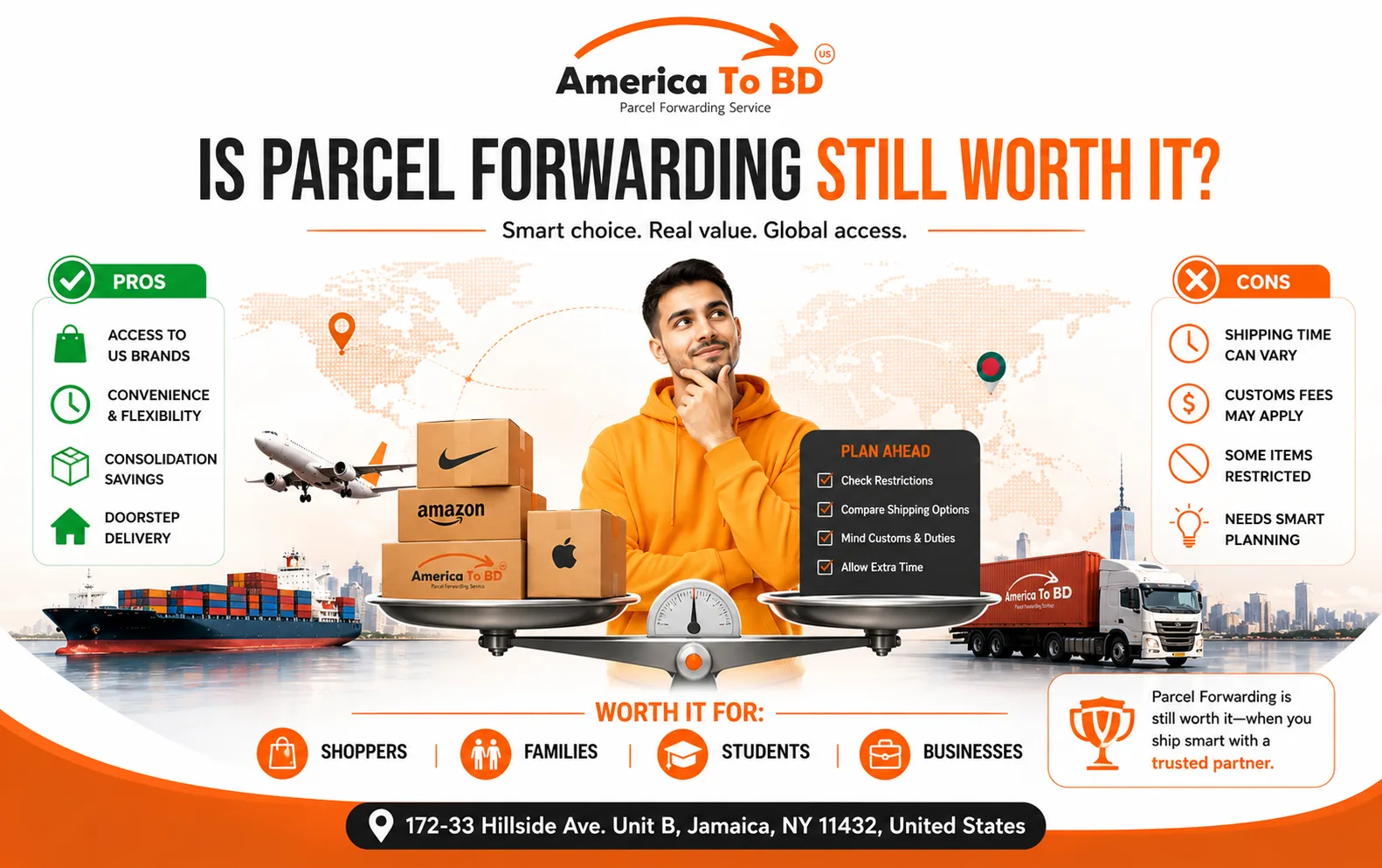
Is Parcel Forwarding Still Worth It?
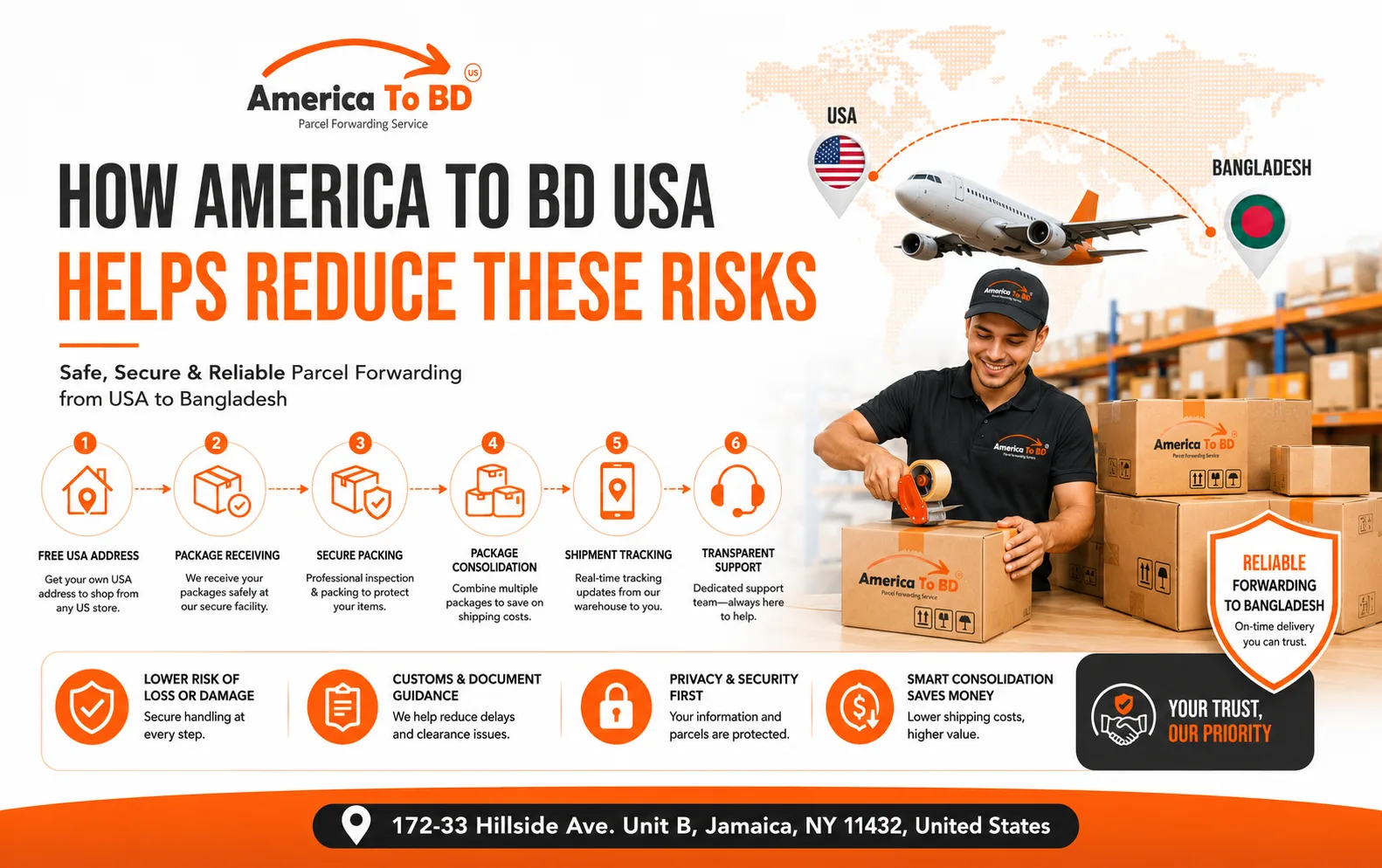
How America To BD USA Helps Reduce These Risks
Frequently Asked Questions
Is parcel forwarding safe?
Why is my forwarded package stuck in customs?
Will I have to pay customs duty on a forwarded package?
What items can't be shipped through a parcel forwarder?
Why does my package cost more to ship than I expected?
Can I return an item after it's been forwarded internationally?
How long does parcel forwarding to Bangladesh typically take?
Conclusion